
Norton County Arrest Records and Charges
Arrest records are created on the law-enforcement side when a person is arrested or booked. In Norton County, the Sheriff's Office publishes a simple current inmate page, but the research did not find a searchable mugshot or booking database. The visible jail list is limited: entries show inmate name, date booked, charge, and bond. It does not show a full booking number, demographics, arresting agency, court date, release date, or detailed charge history in the text inspected.
Court charges after arrest are different. Law enforcement may arrest or cite a person, but the Norton County Attorney prosecutes crimes referred by law enforcement when the matter is filed in District Court. Once the charge is filed, the Clerk of the District Court keeps the court record that tracks charges, bond entries, appearances, pleas, motions, disposition, sentencing, and payments. For the full case file and outcome, use Norton County criminal court records.
Find Norton County Arrest Records
Start with the record type needed. If the goal is current custody, check the Norton County inmate list or contact the Sheriff's Office. If the goal is the filed charge, search the District Court case through Kansas Case Search or use the public terminal in the Clerk of the District Court office. If a copy is needed, send a specific request to Clerk of the District Court Janelle Morel by fax, mail, email, or in person.
- Check whether the person is in current local custody through the Sheriff's Office inmate page or by calling the sheriff's number.
- Search Kansas Case Search by defendant name or case number for the District Court case.
- Open the case summary and read each charge, count, bond entry, appearance, and current disposition.
- Request the complaint, order, judgment, or disposition from the Clerk of the District Court if a document copy is needed.
- For municipal ordinance or city traffic charges, contact Norton Municipal Court directly.
The Sheriff's Office staff directory is a local source for law-enforcement contacts. The Norton County sheriff staff directory is shown here because arrest records begin with the law-enforcement side.
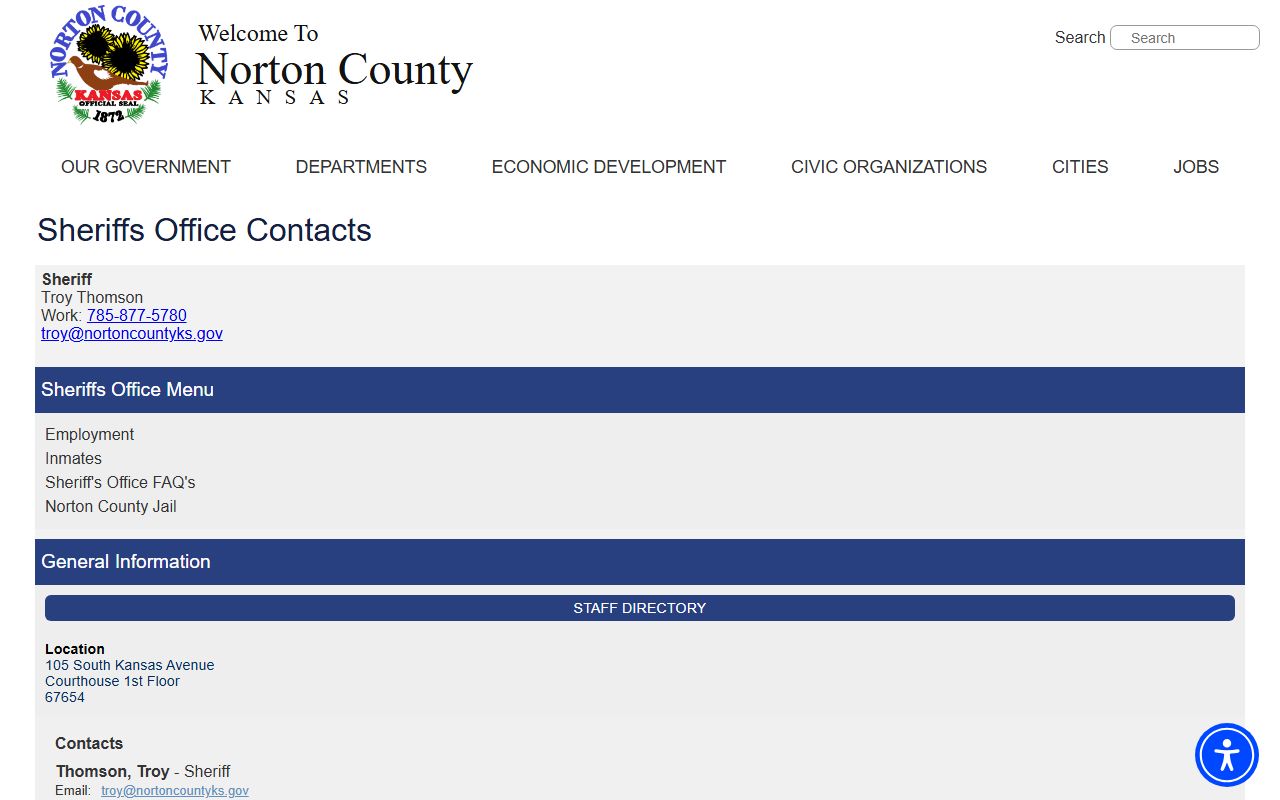
That contact channel is useful for custody questions, while formal court charges are tracked by the court case.
Norton County Charges After Arrest
The charge record begins when a formal charging document is filed. Kansas criminal records may use terms such as complaint, information, and indictment. The research did not identify a Norton County grand jury process page, so the safest local copy is to explain the document types generally while tying filed District Court charges to the County Attorney's prosecution role. One arrest can lead to one charge, several counts, amended charges, or no filed District Court case.
| Charging Document | Who Files or Initiates It | What It Does |
|---|---|---|
| Complaint | Prosecutor or law-enforcement-supported filing | States the criminal allegation that starts or supports a court case. |
| Information | Prosecutor | Formally charges offenses in District Court after prosecutorial review. |
| Indictment | Grand jury | Charges offenses by grand jury action when that route is used. |
Norton County Charge Status
Charge status can change as a case moves. The first charge listed in jail or at filing is not always the final charge. The County Attorney may amend, reduce, dismiss, or proceed on a charge. A judge may enter orders, set hearings, accept a plea, receive a verdict, or sentence after conviction. This is why the court docket and disposition should be checked rather than relying only on the booking charge.
| Status | What It Means |
|---|---|
| Pending | The charge has been filed or remains unresolved in the court case. |
| Amended | The original charge was changed by later filing or court action. |
| Reduced | The charge was changed to a less serious offense or lower severity level. |
| Dismissed | The charge was ended without conviction on that count. |
| Diverted | Prosecution continues under an agreement while the defendant completes conditions. |
| Convicted | The charge ended in a guilty finding, plea, or judgment that supports sentencing. |
Norton County Charges vs Convictions
An arrest is not a conviction, and a charge is not proof that the charge was sustained. Norton County jail entries may show a charge such as bond revocation or probation violation, but the District Court case must be read to determine the formal charge status and outcome. A dismissed, amended, or diverted charge should not be described as a conviction unless the court record shows a conviction.
| Charge | Conviction | |
|---|---|---|
| Meaning | Formal allegation filed after arrest, citation, or law-enforcement referral. | Final court outcome after guilty plea, verdict, or judgment. |
| Timing | Early or mid-case and subject to change. | After disposition and before or with sentencing. |
| Where to verify | Complaint, information, docket, or charge list. | Disposition, judgment, sentencing entry, or certified copy. |
| Record risk | May later be dismissed, amended, or reduced. | May carry sentence, supervision, fines, costs, or collateral effects. |
Norton County Court Charge Filing
The Norton County Attorney office is at 102 E Lincoln Street, P.O. Box 427, Norton, KS 67654. The phone number is 785-874-3262, and the fax number is 785-877-3506. The office hours listed in the research are Monday-Thursday 8:30-4:00 and Friday 8-12:00. The office prosecutes crimes referred by law enforcement agencies, handles children in need of care matters, files care and treatment petitions, handles appellate litigation, aids law enforcement in investigation, and provides counsel and drafts subpoenas or search warrants.
Norton County Attorney
102 E Lincoln Street
P.O. Box 427
Norton, KS 67654
785-874-3262
Fax: 785-877-3506
Monday-Thursday 8:30-4:00; Friday 8-12:00
Norton County Charge Records and Warrants
Some arrest-to-charge records intersect with warrants. A bench warrant may follow a missed court date or failure to comply. A search warrant is different: it authorizes a search or seizure when probable cause is shown. The County Attorney's listed duties include assisting law enforcement in investigation and drafting subpoenas or search warrants, which links charging work to investigation records. Active warrant confirmation should not be promised through the court by phone, because Norton County warns that the District Court cannot tell callers about outstanding warrants.
Kansas search-warrant law requires probable cause and particular description. The K.S.A. 22-2502 search-warrant issuance page is shown here because warrant filings can appear near arrest and charge activity.
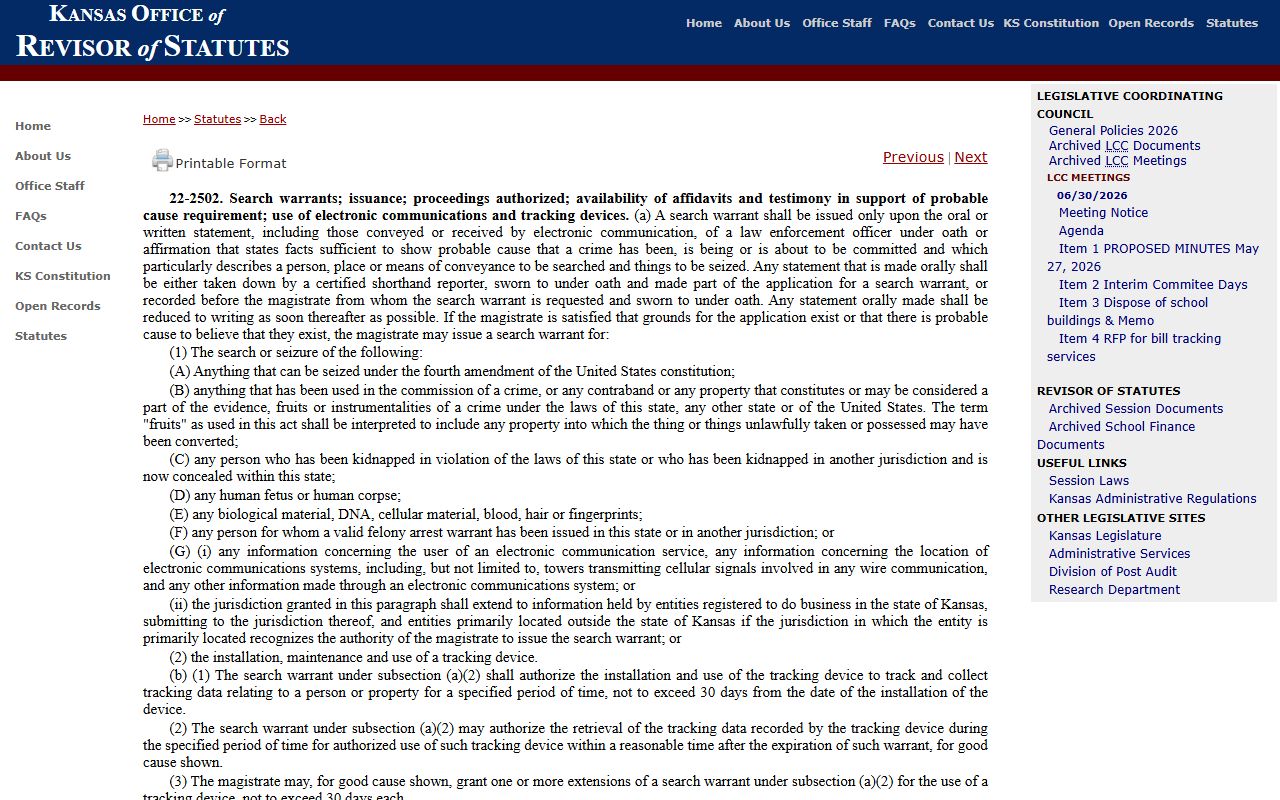
Search-warrant rules explain investigative authority, while the charge record explains what prosecutors filed in court.
Execution and return rules are separate. The K.S.A. 22-2506 search-warrant execution page is shown here as a source for how search warrants are carried out and returned.
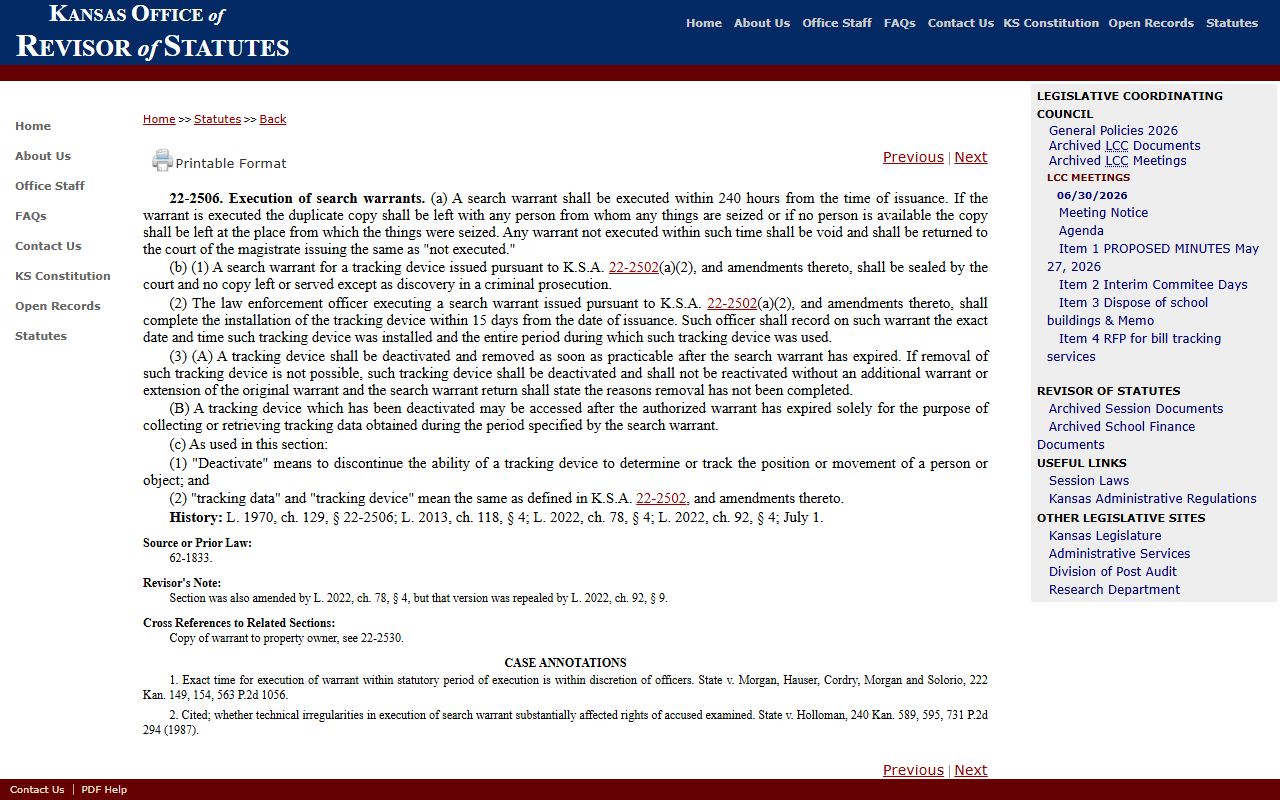
Execution records may be restricted during an investigation, so they should not be confused with ordinary public charge entries.
State Charge and Registry Checks
Statewide sources can supplement a Norton County charge search, but they do not replace the District Court case file. Kansas Department of Corrections KASPER is for state-sentenced offenders and supervision status. The Kansas Bureau of Investigation offender registry is for offender-registration records. K.S.A. 22-4909 permits public access to many registration records while protecting victim identity, Social Security numbers, nonconviction arrests, travel or immigration document numbers, and internet identifiers.
The manifest row for the KBI offender registry image did not have a successful filename, so no image is used for that failed capture. Use official state and county sources rather than third-party aggregator listings when checking charges after arrest.
Restricted Norton County Charge Records
Public access has limits. Juvenile charge records are not ordinary public records. Adoption and care and treatment matters are restricted. Sealed records should not show in public search. Expungement under K.S.A. 21-6614 can limit public access to eligible convictions, arrest records, and diversion agreements after statutory conditions are met. Public copies may also redact protected addresses, victim identity, minor information, Social Security numbers, financial accounts, sealed attachments, and law-enforcement-sensitive details.
| Sealed | Expunged | |
|---|---|---|
| Public search | Hidden from ordinary public search while sealed. | Public access is limited after the court grants expungement. |
| How it happens | By law, case type, or court order. | By petition and order under Kansas expungement rules. |
| Applies to | Protected filings, juvenile matters, adoption, care and treatment, or sealed attachments. | Eligible convictions, arrest records, and diversion agreements. |
| Practical effect | The record may exist but is not open to general public access. | The record is not treated as an ordinary public record, but some official uses may remain. |
Note: A missing public result can mean the record is restricted, not that the arrest or court charge never existed.