
Norton County Probate Records Overview
Probate in Norton County is handled in District Court. The county's District Court materials list probate among the case categories maintained by the Clerk of the District Court, and no separate Norton County probate court website or probate clerk was located in official sources. That means estate and fiduciary records are searched, requested, and certified through District Court channels.
Probate record types can include wills, petitions for probate, petitions for administration, letters testamentary, letters of administration, notices to creditors, inventories, claims, accountings, trust-related petitions, final settlements, and closing orders. Guardianship and conservatorship filings may also appear in the probate area, but those files often contain sensitive personal, financial, medical, or minor information.
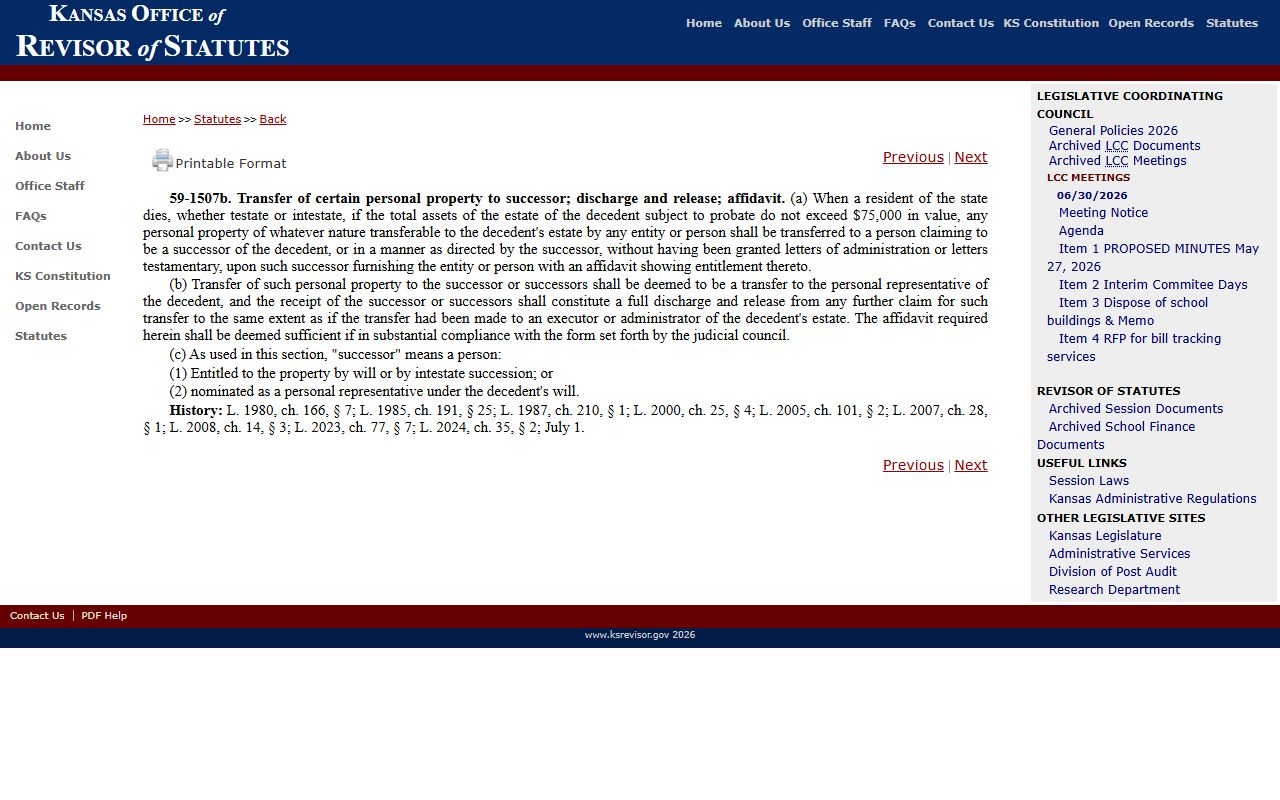
The small-estate statute is available at K.S.A. 59-1507b.
Norton County Probate Terms
Probate records use terms that are easy to misread in a search result. These definitions keep the core case roles clear before a request is sent to the Clerk of the District Court.
- Testator
- A person who made a will before death.
- Executor
- A person named in a will to carry out its terms, sometimes called a personal representative in court practice.
- Intestate
- A death without a valid will, which can require administration under Kansas law.
- Guardianship
- A court case about care and decision-making for a minor or an adult who needs a guardian.
- Conservatorship
- A court case focused on managing money or property for a person who cannot manage those assets alone.
Search Norton County Probate Records
Norton County probate records use the same access channels as other District Court case records. Start online for public case information, then use the courthouse terminal or a direct clerk request when a probate case is older, not fully visible, document-specific, or needs certification.
- Search Kansas Case Search for public District Court probate case information if the case is recent and public.
- Use the public access terminal in the Clerk of the District Court office when the online portal does not show enough detail.
- Submit a specific request by fax, mail, email, or in person if copies are needed.
- Include the case number if known, the estate or protected person's name, and the exact documents requested.
- Wait for the clerk's response and cost quote before expecting delivery of copies.
Public probate searches may show limited case information rather than every filed paper. A certified will, letters, order, or closing document should be requested by document name when possible.
Norton County Probate Court Contact
The Probate Division of District Court is housed with the Clerk of the District Court. This is the official local contact for Norton County probate case files, public terminal access, copy requests, and certification questions.
Probate Division of District Court
Office: Clerk of the District Court
Norton County Courthouse, 3rd Floor
105 S. Kansas Avenue, P.O. Box 70
Norton, KS 67654
785-877-5720
Fax: 785-877-5722
Email: ntdc@kscourts.gov
Monday-Friday, 8:00 a.m.-12:00 p.m. and 1:00 p.m.-5:00 p.m.
Norton County Probate Fee Table
Only fees located in the research are listed. No official Norton County estate-opening fee was found during this research pass, so an estate filing amount is not invented. Confirm filing costs with the clerk before filing because statewide fee pages and local practice can change.
| Item | Researched Fee or Rule |
|---|---|
| Guardianship of an adult | $91.50 listed in inspected Kansas Self-Help fee result |
| Guardianship of a minor child | $91.50 listed in inspected Kansas Self-Help fee result |
| Conservatorship | $91.50 listed in inspected Kansas Self-Help fee result |
| Printed District Court documents | $0.25 per page |
| Larger-request research fee | $5.00 may be assessed |
| Certification | $1.00 per certification |
| Opening a probate estate | No local official fee found in the provided Norton County research |
The federal bankruptcy page in the manifest is separate from county probate, and its source is the U.S. Bankruptcy Court for the District of Kansas.
Norton County Small Estates
Kansas allows transfer of certain personal property by affidavit when a resident dies and the total assets subject to probate do not exceed $75,000. This rule can reduce the need for a full probate case, but it does not fit every estate. Real property, disputes, creditor issues, missing heirs, or assets outside the threshold may still require court filings.
When a full Norton County probate case is opened, the court may receive a petition, will if one exists, death information, heir or beneficiary details, property information, and a request for fiduciary authority. The court can issue letters, require notice, track claims, review inventory or accounting, and enter final settlement or closing orders.
What Norton County Probate Records Show
No live probate case was opened during research because portal inspection was blocked. Based on Norton County's local District Court record description and the probate research, public probate records may show a case number, estate or decedent name, filing date, case type, assigned judge, petitioner or personal representative, attorney, docket entries, orders, letters, inventory or accounting status, claims, hearing dates, and closing disposition.
The District of Kansas CM/ECF source is a federal filing system, not the Norton County probate docket. Its source page is available at District of Kansas CM/ECF.
Restricted Norton County Probate Records
Some estate filings are public, but probate-adjacent records can contain private facts. Guardianship, conservatorship, minor, medical, care, treatment, sealed, and protected financial material may be restricted or redacted. A public docket entry does not guarantee access to every attachment or report.
For lawfully available copies, use the clerk's direct request process and ask for the exact document. Broad requests for a whole probate file can cost more, take longer, and still exclude restricted material.