
Norton County Criminal Court Records
A criminal court record is the case-level file kept by the Clerk of the District Court after charges are filed in court. Norton County lists criminal cases among the records kept by the District Court office. The case file can include the complaint or other charging document, bond entries, preliminary-hearing activity, arraignment, pleas, motions, court orders, trial verdicts, sentencing entries, probation terms, financial entries, and judgment records. The charge itself is only one part of the larger criminal case file.
Norton County District Court is part of Kansas' 17th Judicial District. It is the local trial court of general jurisdiction for criminal matters filed in District Court. Municipal ordinance and city traffic matters may sit in Norton Municipal Court instead. The County Attorney prosecutes crimes referred by law enforcement agencies, handles appellate litigation, assists law enforcement in investigation, and drafts subpoenas or search warrants when needed.
The Norton County Attorney source is important to criminal case records because prosecution starts the court case after law enforcement referral. The Norton County Attorney page is shown here as the local prosecution source tied to criminal court records.
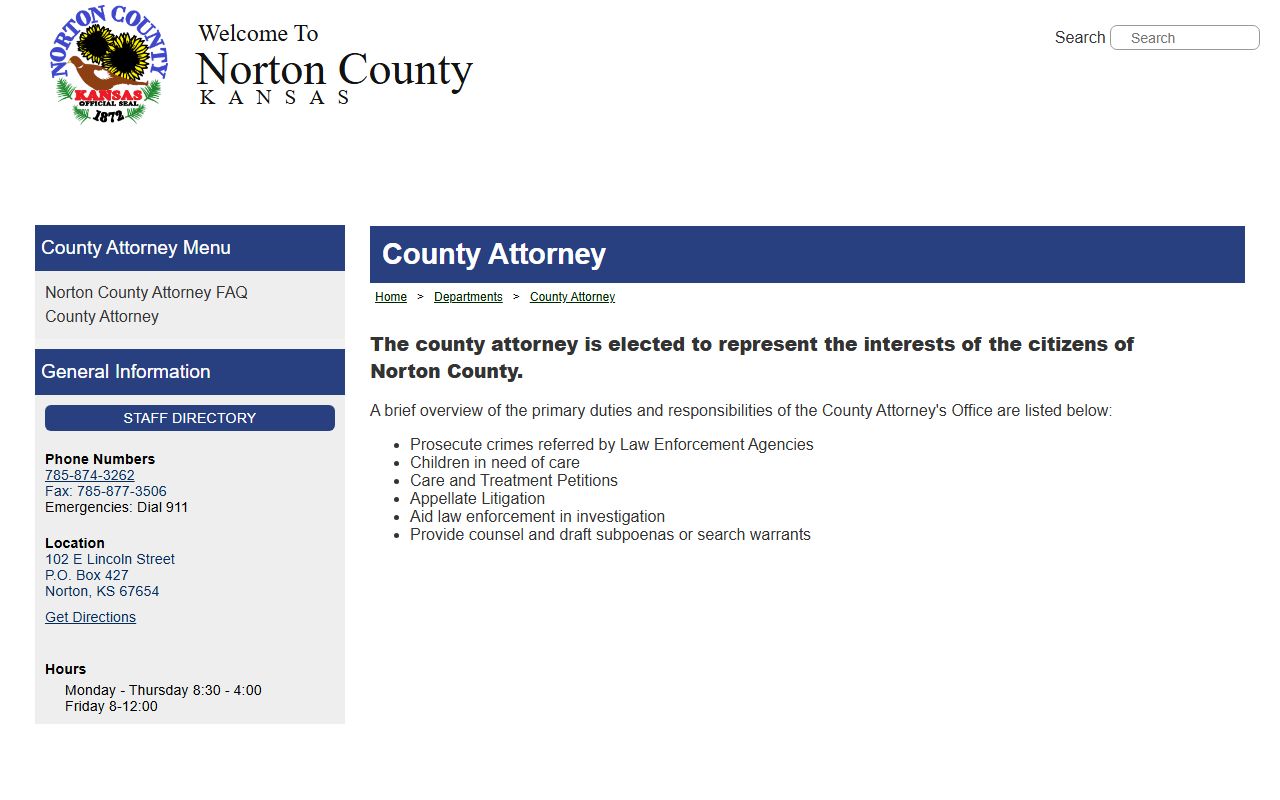
That office does not replace the Clerk of the District Court for case copies, but it explains who prosecutes the charges.
Search Norton County Criminal Court Records
Start with Kansas Case Search for public District Court criminal case information and public documents. Search by case number when known. If only the defendant name is known, search by party name and narrow to Norton County or the 17th Judicial District if the portal provides that option. The public terminal in the Clerk of the District Court office is the next route when online results are thin or a document is not visible.
- Open Kansas Case Search and search for the public criminal District Court case.
- Use the case number, or search by defendant name if the number is unknown.
- Review the docket for charges, appearances, motions, orders, disposition, sentence, and payments.
- Check whether the charge is still pending, dismissed, amended, or resolved by plea, verdict, or other disposition.
- Request certified copies from the Clerk of the District Court when a legal copy of a complaint, order, judgment, or disposition is needed.
For local copies, Norton County accepts requests by fax, mail, email, or in person. Requests must be specific and should include the case number and exact documents wanted. The Clerk's Office has three business days to respond, then provides a cost quote before sending documents after payment. Public terminal searches have no search fee, printed pages cost $0.25 per page, larger requests may trigger a $5 research fee, and certification costs $1 per certification.
Norton County Criminal Case Flow
A criminal court record changes as the case moves from filed charges to final action. The docket may begin with a complaint or other charge filing, then show first appearance or arraignment, bond entries, motions, hearing settings, plea or trial events, disposition, sentencing, probation conditions, and payment activity. Court Services may appear in the record when the court orders bond supervision, probation supervision, predispositional reports, or presentence investigation reports.
Case flow: Charges Filed › Arraignment › Pretrial / Motions › Plea or Trial › Disposition › Sentencing
| Stage | What Happens |
|---|---|
| Charges Filed | The County Attorney files or prosecutes formal charges referred by law enforcement. |
| Arraignment | The defendant appears, the charges are addressed, and a plea may be entered. |
| Pretrial / Motions | The docket may show motions, orders, discovery disputes, continuances, and hearing settings. |
| Plea or Trial | The case may resolve by guilty, not guilty, or no contest plea, or proceed to verdict. |
| Disposition | Each charge receives a current or final outcome, such as dismissed, guilty, acquitted, or diverted. |
| Sentencing | The court may enter jail, prison, probation, fines, costs, restitution, or other ordered terms. |
Norton County Criminal Record Fields
Norton County says the District Court record is chronological and includes papers filed, process requests issued, returns made, appearances, orders, verdicts, judgments, and payments. In a criminal file, those entries let a reader separate the allegation, the procedural history, the outcome, and the sentence. A public copy may still omit sealed filings, protected identifiers, victim information, juvenile material, and other restricted content.
| Field | What It Shows |
|---|---|
| Case Number / Type | The criminal case type and consecutive number assigned in District Court. |
| Defendant | The person charged in the criminal case, with protected identifiers redacted from public copies. |
| Charges / Counts | Each alleged violation, often listed as separate counts that may change during the case. |
| Bond / Appearance | Release or bond entries and court appearances such as first appearance or arraignment. |
| Motions / Orders | Requests filed by parties and the judge's rulings or directives. |
| Plea / Verdict | Whether a charge was resolved by plea, trial verdict, dismissal, or another disposition. |
| Sentence | Jail, prison, probation, fines, costs, restitution, supervision, or other court-ordered terms. |
| Payments | Financial activity tied to fines, costs, restitution, bond, or collection status. |
Norton County Charges vs Convictions
A charge is an accusation filed in court. A conviction is an outcome after a guilty plea, no contest plea accepted as a conviction where applicable, or verdict. Norton County criminal court records can show charges that were amended, reduced, dismissed, diverted, or resolved without conviction. That is why the disposition field matters as much as the charge label.
| Charge | Conviction | |
|---|---|---|
| Meaning | An allegation that a person violated a criminal, traffic, or fish and game law. | A final finding or accepted plea that results in a criminal judgment. |
| Timing | Appears early in the case and may change. | Appears after plea, verdict, or final disposition. |
| Record value | Shows what was filed, not what was proven. | Shows the adjudicated outcome and often links to sentencing. |
| Copy need | Complaint or information may be needed. | Judgment, disposition, or sentencing order may be needed. |
For the arrest-to-charge pathway and filed charge status, use the separate Norton County arrest records and court charges resource.
Norton County Sealed vs Expunged
Sealing and expungement both limit public access, but they are not the same. A sealed record is hidden from ordinary public search by court order or law. An expunged Kansas record is limited under the expungement statute after the person qualifies and the court grants relief. Kansas expungement can apply to certain convictions, arrest records, and diversion agreements, but it has waiting periods, exclusions, and continuing uses in some criminal justice and licensing settings.
| Sealed | Expunged | |
|---|---|---|
| Public visibility | Not shown in ordinary public search while sealed. | Public access is limited after the court grants expungement. |
| Common source | Court order, protected case type, or statutory confidentiality. | Petition under Kansas expungement law when eligibility is met. |
| Examples | Sealed filings, adoption, juvenile, care and treatment, or protected attachments. | Eligible convictions, arrest records, and diversion agreements under K.S.A. 21-6614. |
| Still may exist | Yes, but public access is restricted. | Yes, limits public access but does not mean every government record is physically destroyed. |
Kansas adult expungement rules are central to criminal case access. The K.S.A. 21-6614 expungement page is shown here as a source for eligible convictions, arrest records, and diversion agreements.
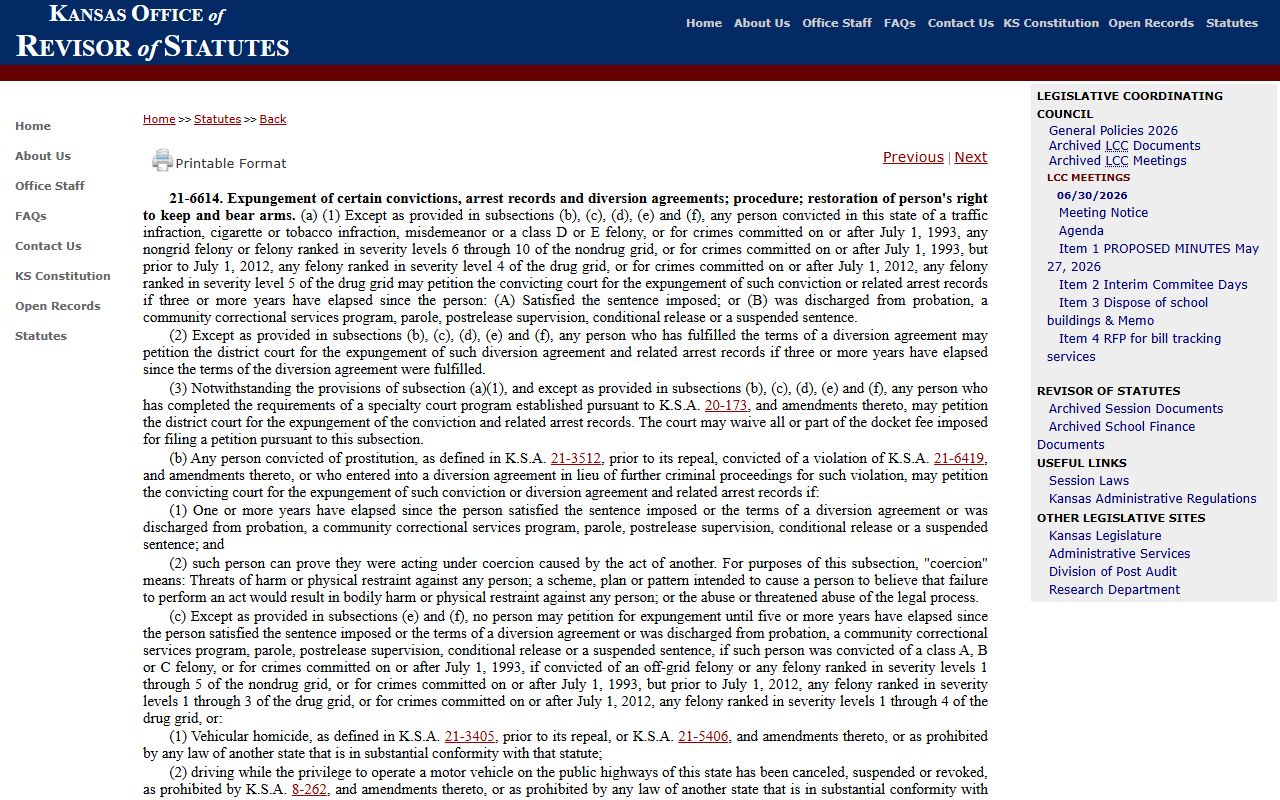
Adult expungement is a court process, so the Norton County District Court case number is often needed.
Norton County Criminal Records Access
Kansas Open Records Act policy favors public access to public records unless another law permits closure. Criminal court records also carry court-specific limits. Juvenile cases are not ordinary public files, and K.S.A. 38-2312 provides a separate juvenile expungement process. Offender registry information is generally public under K.S.A. 22-4909, but the law protects victim identity, Social Security numbers, nonconviction arrests, travel or immigration document numbers, and internet identifiers.
The Kansas Bureau of Investigation maintains state-level criminal and investigative information sources, but those do not replace the Norton County District Court file. The Kansas Bureau of Investigation media releases page is shown here as a state source separate from local criminal court records.
A media release or state record may describe an event, while the District Court record shows the filed case and outcome.
Juvenile expungement is governed separately. The K.S.A. 38-2312 juvenile expungement page supports the access limits for juvenile criminal-type records.
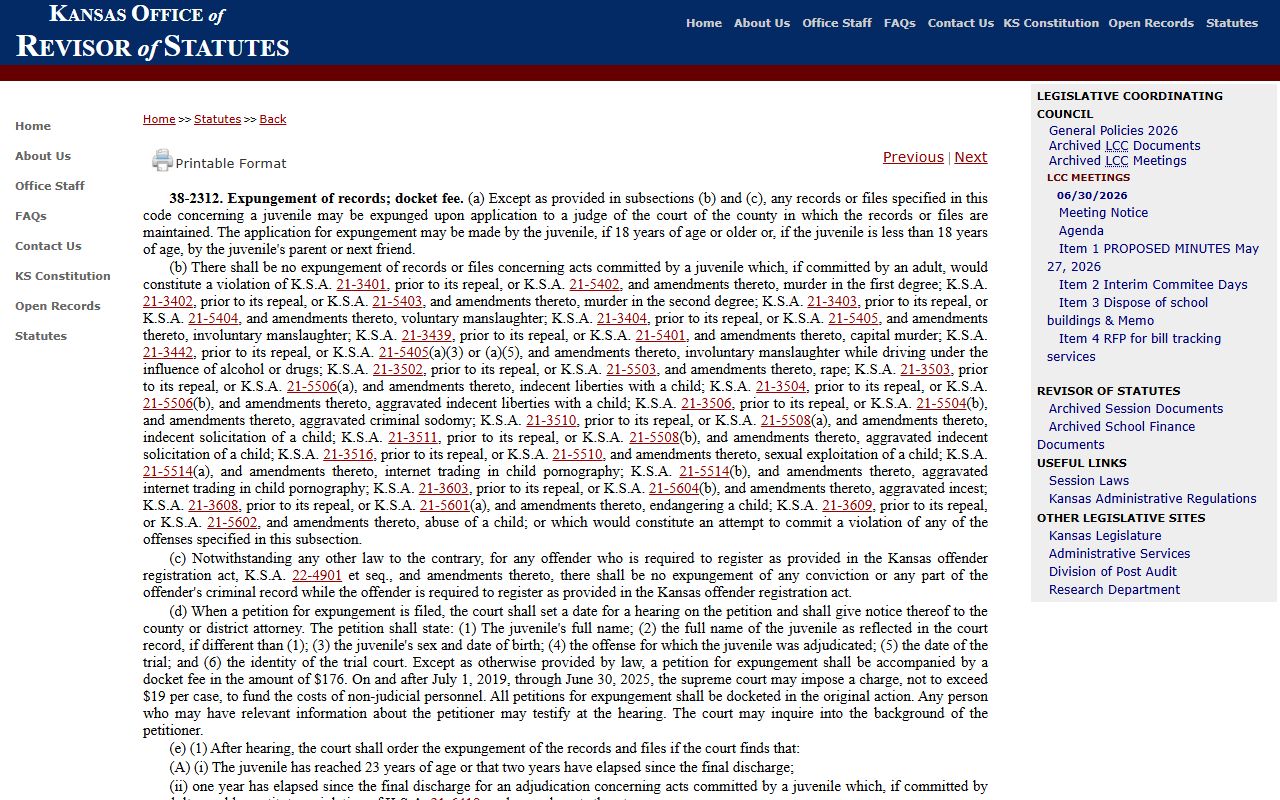
That separate statute is why juvenile case material should not be treated like adult criminal court records.
Restricted Norton County Criminal Records
Public searches should not reveal sealed cases, sealed records, juvenile matters, adoption files, care and treatment records, protected victim information, Social Security numbers, financial account data, minor information, and other exempt material. Presentence investigation reports, supervision material, and law-enforcement-sensitive attachments may also be limited. If a record is missing from public search, the next step is to ask the Clerk of the District Court about lawful access, not to assume the case was never filed.
Offender-registration records have their own public-access and nondisclosure rules. The K.S.A. 22-4909 offender-registration access page is shown here because it explains public access while protecting specific sensitive data.
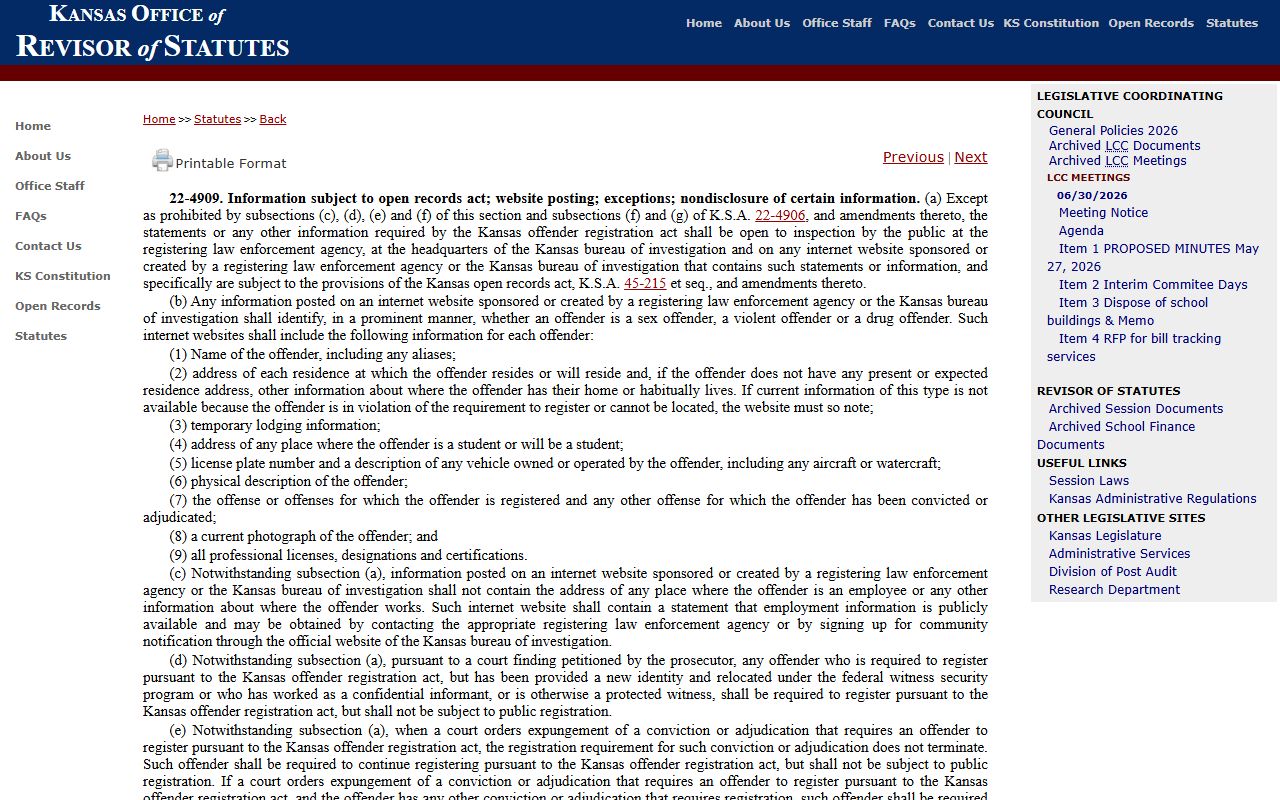
Registration data can be public in part while still withholding protected nonconviction, victim, and identity details.